
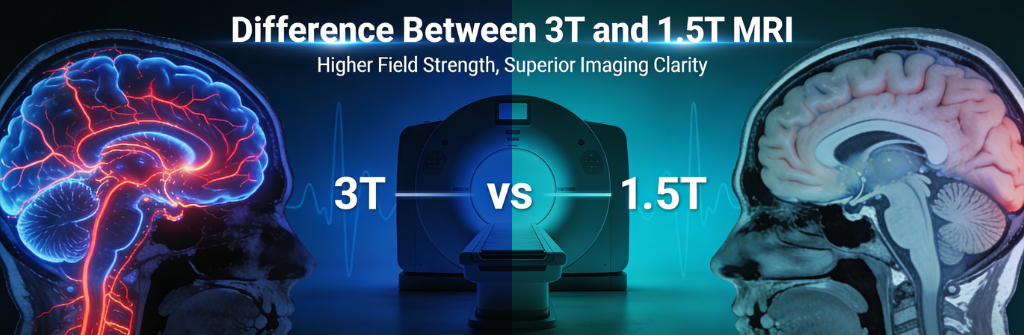
When your doctor recommends an MRI scan, you may hear terms like 1.5 Tesla MRI or 3 Tesla MRI and wonder what they actually mean. Many patients also ask whether a stronger magnet gives better results and how it affects the cost of the scan.
In this guide, we explain the difference between 3T and 1.5T MRI, when each is used, and whether magnet strength truly matters for diagnosis – so you can make an informed decision before booking your scan.
What Does “Tesla” Mean in MRI Scan?
Tesla (T) refers to the strength of the magnetic field used by the MRI machine.
- 1.5T MRI = Standard magnetic strength
- 3T MRI = Stronger magnetic field (about double)
Understanding 1.5T MRI: Reliable and Widely Used
A 1.5 Tesla MRI is the most commonly used MRI worldwide. It provides high-quality images and is suitable for most routine scans.
Best uses of 1.5T MRI:
- Brain MRI (routine evaluation)
- Spine MRI
- Joint MRI (knee, shoulder, ankle)
- Abdominal and pelvic scans
- Patients sensitive to noise or claustrophobia
Advantages:
- Excellent diagnostic accuracy
Shorter wait times - More comfortable for many patients
- Generally more affordable
What Makes a 3T MRI Different?
A 3 Tesla MRI uses a stronger magnetic field, which allows it to capture more detailed and sharper images. This can be especially helpful when doctors need to see very fine structures.
When doctors prefer a 3T MRI:
- Neurology cases (epilepsy, brain tumors, MS)
- MRI brain with advanced protocols
- Small ligament or cartilage injuries
- MR angiography (blood vessels)
- Research or complex diagnostic cases
Key benefits of 3T MRI:
- Higher image resolution
- Better clarity for small abnormalities
- Faster scan time for certain studies
- Improved detection in complex conditions
Also Read: How to Prepare for Your Brain MRI Scan
Does Magnet Strength Really Matter?
Yes – But only in certain situations.
- For routine scans, a 1.5T MRI is usually more than sufficient.
- For complex brain, nerve, or vascular cases, a 3T MRI may provide additional diagnostic value.
- Stronger magnet ≠ always necessary.
3 Tesla MRI Price in Delhi: What Should You Expect?
One of the most common patient questions is about cost.
The 3 tesla mri price in delhi is generally higher than a 1.5T MRI, mainly because of:
- Advanced technology
- Higher operational costs
- Specialized imaging protocols
That said, prices can vary depending on:
- Body part being scanned
- Use of contrast dye
- Diagnostic centre location
- Reporting expertise
At CareBox, we focus on transparent pricing, accurate reporting, and ensuring patients are advised only when a 3T MRI is truly required.
Is a 3T MRI Safe?
Yes. Both 1.5T and 3T MRI scans are safe, non-invasive, and radiation-free.
However:
- Patients with implants or metal devices must inform staff in advance.
- Some people may notice slightly louder noise in 3T MRI.
- Contrast use is decided carefully based on medical need.
Related Article: 3 Tesla MRI: Know About the Technology Transforming Diagnostics
Which MRI Should You Choose?
Here’s a simple way to decide:
| Condition Type | Recommended MRI |
| Routine brain, spine, joints | 1.5T MRI |
| Epilepsy, tumors, MS | 3T MRI |
| Sports injuries (detailed) | 3T MRI |
| General screening | 1.5T MRI |
Why Choose CareBox?
- NABL-standard diagnostic quality centres
- Experienced radiologists
- Advanced MRI technology
- Affordable MRI Scan price in delhi
- Clear guidance on scan selection
- Affordable and transparent pricing
Final Thoughts
The debate between 3T vs. 1.5T MRI is not about which is better overall—but which is better for your condition. While a 3T MRI offers higher detail, a 1.5T MRI remains the gold standard for many diagnostic needs.If you’re comparing options or checking the 3 tesla mri price in delhi, make sure your choice is guided by medical necessity, not just technology claims.
