
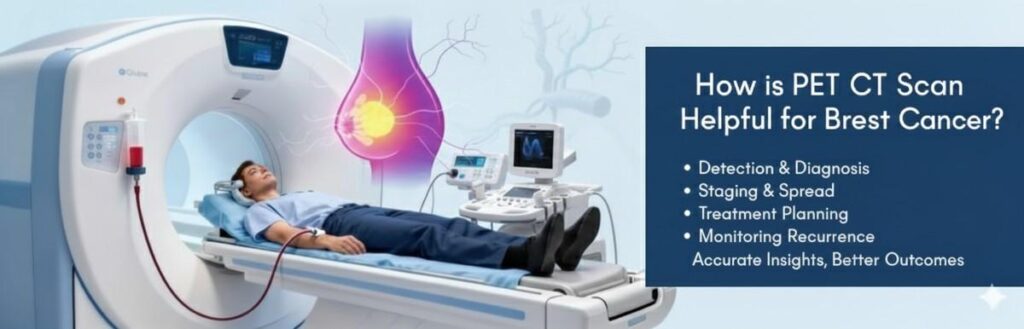
It is more prevalent in the female population in comparison to the male population. This condition results from the development of abnormal cells that subsequently develop in an uncontrollable way, thereby giving rise to the formation of tumors.
Breast cancer is accountable for about 25% of all the instances of cancers that develop in women. If not attended to, the condition is fatal, as the tumor develops the capacity to travel to distant regions. PET CT is an efficient technique used in the detection of breast cancers.
PET-CT is used in the detection of breast cancers due to its capacity to administer radioactive materials in the search for breast cancers in tissues. An example of an ionizing tracer used in the detection of breast cancer is the 18F-fluorodeoxyglucose (FDG PET CT Scan).
What Is Breast Cancer?
Breasts are glandular tissues consisting of connective tissue, fat, and breast tissues. Breasts are the mammary glands that are involved in providing nutrition to the offspring and are located on the chest. Any malady in the breasts may result in the improper functioning of the breasts. Among such maladies, one comes out to be breast cancer.
This may result because of the uncontrolled growth of the cells of the breasts that lead to the formation of tumors. If such an instance goes untested and untapped, it may lead to the spreading of the malady to other parts of the body. For controlling the level of damages, the detection of the malady called cancer can lead to recovery from such circumstances shortly. For such detection and controlling the damages, the PET CT scan plays an imperative role.
What Are The Main Reasons For Breast Cancer?
There is no identified cause with regard to the incidence of breast cancer, although there are some identified risks that have been linked to the incidence of breast cancer. The identified risks include genes, family, age, imbalance of hormones, obesity, as well as smoking.
It is estimated that one-quarter of cancer-inducing deaths among women can be related to the incidence of breast cancer, since it is preventable if the woman with cancer changes her lifestyle by not taking any form of alcohol, radiation, as well as other risks that might be involved in creating breast cancer.
What Kinds Of Breast Cancers A PET-CT Scan Will Reveal?
PET CT scans are capable of identifying various types of breast cancers. There are multiple types of breast cancers. These include:
- Invasive ductal carcinoma
- Invasive lobular carcinoma
- Inflammatory breast cancer
- Breast cancers that are triple-negative Carcinoma in situ, Phyllodes T
- Paget’s diseases of the breasts Some of these kinds of breast cancers are mentioned below,
What Is The Procedure For PET-CT Scan In Detecting Breast Cancer?
Breast cancer can be identified at the early stage by the use of the PET-CT scan and helps in getting treated at the early stage of the cancer. The breast cancer procedure includes the usage of the radioactive tracer, i.e., 18F-Fluorodeoxyglucose (FDG). The patient is made to wait for a period of 1 hour until the drug affects the body.
The radioactive glucose is absorbed by the body during the procedure, and the scan helps in generating the 3D image, thereby identifying the condition and helps in early detection.
What Can I Determine From Each Stage Of Development, Related To PET-CT Scanning?
The various stages of development are as follows:
- Verification of Breast Cancer.
- Location of Spread into Other Body Tissues.
- Detection of Recurring Breast Cancers.
- Continued Monitoring of Breast Cancer Treatments.
- Cellular Verification For All Stages.
- Identification Of Any Abnormal Cellular Activity.
- Identification Of All Functioning and Non-functioning Cells.
What Are The Various PET-CT Scans Available For Breast Scan?
Here is the list of PET-CT scans available except for the Breast scan.
- Breast PET Scan
- F-18 Choline PET Scan
- FDG-PET Scan
- DOTA PET CT Scan
- Whole Body PET Scan
- PSMA PET Scan For Prostate
- Dopa Brain PET SCAN
- PET Viability Scan Cardiac
- Cardiac PET Scan
Conclusion
Breast cancer is more common in females than males and is the development of abnormal cells that divide in uncontrolled manner and leads to the formation of tumours. Globally breast cancer accounts for about 25% of all cancers in women. PET-CT is an effective tool for the detection of breast cancers and helps to detect the condition early. Early detection helps in effective treatment and controls the spread.
Frequently Asked Questions
Q. What Are The Side Effects Of A PET Scan?
Following are typically safe, with an array of relatively mild side effects that are typically short-lived (headaches or dizziness) (nausea) (mild discomfort or redness) when using radiopharmaceuticals or contrast material that are utilized during PET scanning.
Q. Is A PET CT Scan Painful?
In most cases, PET CT scans will not, in any way, induce any pain or discomfort. PET CT scans are usually non-invasive, which means they will cause the subject very little, if any, pain or discomfort.
Q. What Are The Advantages And Disadvantages Of A PET Scan?
Benefits include: early disease diagnosis (cancer, brain, heart); assessing response to therapy; functional studies, while disadvantages include: exposure to radiation; expense; pseudoeffects with inflammation; other practicalities: trace distribution, patients with: pregnancy claustrophobia.
Q. Is It Serious If You Need A PET Scan?
Having a PET scan is an accepted medical procedure for examining a variety of serious health concerns, but it doesn’t necessarily indicate a serious diagnosis or a condition involving a specific disease, such as cancer. It is a highly useful tool for obtaining information that would not be discovered in a PET scan, for instance.
Q. Who Should You Avoid After A PET Scan?
For a time after a PET scan, you should avoid close contact with some people who are particularly vulnerable. This could be for up to 6 hours and sometimes as long as 24 hours. This is just a precaution, because a small amount of the radioactive tracer will be in your body temporarily.